877-601-6284
Get Started by Finding a Local Center
Customized math tutoring plans that build confidence and lead to true understanding




Mathnasium has made math tutoring fun and exciting for our 5th grader, who needed more of a challenge. The staff and math tutors have been wonderful to work with and the content is impressive. If only we'd found it sooner!



 Learn About Mathnasium
The Mathnasium Method™
Learn More
Delivering our proprietary curriculum face-to-face in a way that makes sense to kids.

Teaching each individual exactly what they need to learn, and building on it.

Our math tutors are trained to make learning math a fun and confidence-building experience.

of parents report an improvement in their child’s math skills and understanding
of students saw an improvement in their school grades
of parents report improved attitude toward math after attending Mathnasium


Mathnasium has been a great fit for my son. He loves attending. In just a few months I have seen a tremendous improvement in his attitude towards math. He loves math.
Jason T., parent, Huntington Beach Center

This isn’t just tutoring. We really wanted our daughter to understand math concepts and feel confident going into high school. Mathnasium does that and more!
Pam M., parent, Mechanicsburg Center
Mathnasium gives your child the opportunity to advance beyond their current grade level.
Learn MoreMathnasium can help your child thrive at their current grade level and unlock the fun in math.
Learn MoreMathnasium's math tutors will help your child catch-up to their school curriculum.
Learn More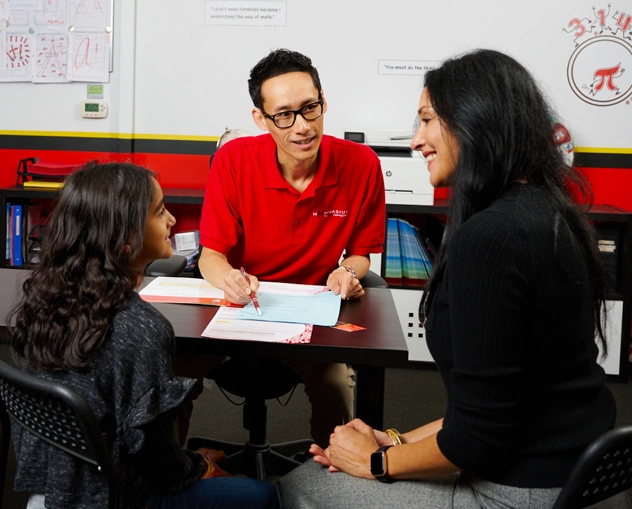
Get answers to common questions to resolve basic outstanding concerns without speaking to someone.
Yes, we do. Mathnasium was established in 2002 and now operates nearly 1,000 learning centers nationwide, providing the best personalized math tutoring nearby. Larry, a teacher, a curriculum consultant, and Mathnasium’s expert on the team, spent years refining math teaching methods.
We have designed fun and engaging techniques to help children understand math easily. And we have highly experienced and qualified math tutors who teach our after-school mathematics programs.
Yes! Not only does your child get the best math tutoring nearby, but they also receive face-to-face instruction. Whether your child takes online or in-center classes, our math tutors focus on the individual. There are no group lectures or classes. We assess each child’s math skills and abilities and customize the math curriculum to help them reach their goals. Your child will get targeted lessons, allowing them to master new material in the way they learn best.
Our proven teaching method helps students build a strong base and expand their math understanding. Our math tutors encourage children to develop mental math abilities, number sense, and problem-solving skills.
Mathnasium uses modern techniques and fun methods to help children fall in love with math instead of getting bored or terrified by lessons. We tailor our instruction to your child’s learning style and needs.
After our comprehensive assessment process, your child receives a fully customized learning plan. Our math experts will tailor their instruction to your child's individual learning needs and style.
Mathnasium’s proprietary curriculum was created by qualified teachers and curriculum consultants whose goal was to make learning easy and approachable for students. Our techniques are different from traditional methods of using schoolbooks to teach children. All children are different, and we will adjust our techniques to provide the best private math tutoring nearby.
Mathnasium’s curriculum focuses on foundational understanding that helps students learn advanced methods. We also use games, activities, and rewards to make learning math fun for your child.
Of course! Children love to engage in fun activities that don’t require them to go through traditional math learning methods. Our math tutors capitalize on everyday experiences to allow children to learn concepts in a way that makes sense to them.
Mathnasium’s teaching methods challenge children and encourage them to learn skills quickly. Our in-center activities and reward incentives also help to make Mathnasium a favorite tutoring system.
Math tutors nearby might help children do homework and practice daily school lessons, but they aren’t always able to develop the important building blocks in students’ minds. Mathnasium uses a curriculum and methodology that has been proven through the success of thousands of students.
The resources of a global organization and extensive training back our teaching methods. Mathnasium’s experts provide better and more focused instruction at an affordable cost.
Our experts will provide homework help to your child during sessions. However, our core curriculum is centered around establishing a better understanding of math, which will enable kids to complete homework on their own in the future. Most of their time at Mathnasium will be spent on our curriculum, but time is set aside for help with homework at every session, as needed.
Our math tutoring ensures that your child understands their homework instead of just getting through it. This takes the burden off parents and allows children to stay on track in school and score higher marks.
No! We don’t burden students with extra homework. Our expert instructors build a strong relationship with students, giving them efficient and effective guidance in their math tutoring sessions every day as they work on specific skills and make good progress during their time in the center. Adding homework would risk frustration and overload.
At Mathnasium, we understand that assessments can sometimes feel stressful for students. That’s why we take a personalized and engaging approach to each assessment. We start by building rapport with your child, giving them a short center tour, and setting expectations.
We conduct both a verbal and written assessment to identify your child’s strengths and areas for improvement as well as to gain a true understanding of how each student approaches and thinks about math. More importantly, our assessments don’t feel like a test – we use interactive methods to ensure your child feels comfortable and confident.
We carefully craft our assessment questions to evaluate specific skills that are critical for success in math. Our assessments cover a wide range of math skills and concepts, including grade-level or subject-specific skills, number sense, and concepts unique to Mathnasium.
We use a combination of verbal and written questions, and it's possible that some of the questions may cover topics your child hasn't yet learned in school. Our goal is to get a comprehensive understanding of your child's current math abilities, so we can create a personalized learning plan that meets their unique needs and goals.

Get started by finding best personalized math tutoring nearby


My student has been frustrated and struggled with math for years. Every session at Mathnasium is nothing but p...
My daughter has been going to Mathnasium for about a year and a half and when she started she was a couple of ...

 877-601-6284